#66 – WORLD DOMINATION
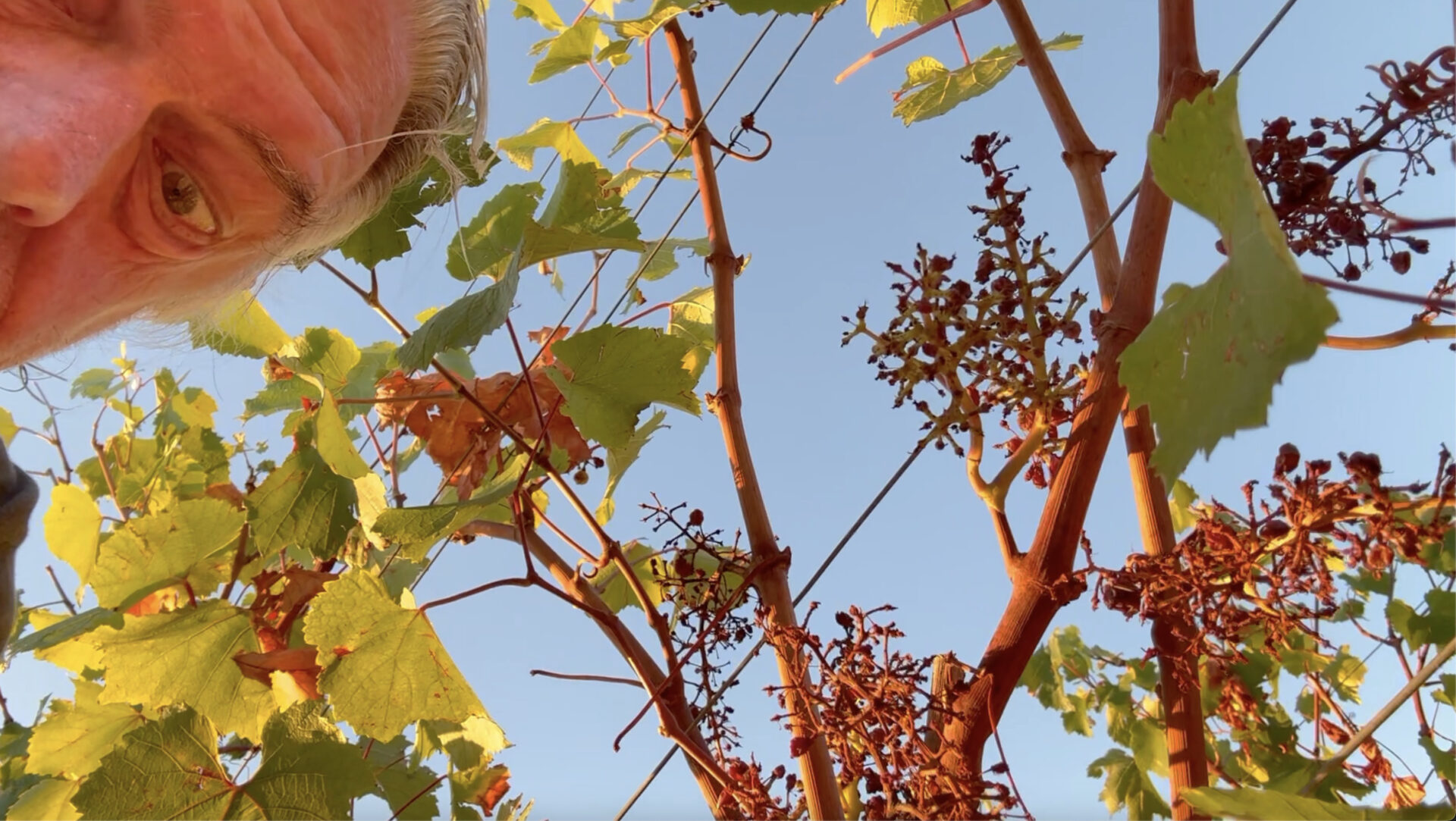
I’m currently driving through France, on the way, to my second home. We stayed in Burgundy last night and when I walked the dogs early this morning, I got lost in a vineyard. Of course I had already heard about the dramatic developments in French wine production, but now the evidence was staring me in the face. Sad little branches with raisins on them. Row after row of unpicked, dried-out bunches of grapes. The estimate is that this year’s production will be 17% lower than the average of the past five years. Drought and extreme heat resulted in smaller grapes, while hail destroyed entire vineyards.
This morning I read in the newspaper about the General Assembly of the United Nations. The theme? Restoring Trust, Managing Transformation.
Strangely enough, the almost 200 countries gathered there don’t disagree about that many things. Hardly anyone disputes that the climate is changing and sea levels are rising. That international action is needed. The Sustainable Development Goals (SDG) agreed upon in 2015 are moving too slowly. The next pandemic will probably cause even bigger problems than COVID-19. And the risks of AI don’t stop at national borders either.
But there were more than enough things they did disagree about. Half the room walked out when Netanyahu began his speech. A majority condemned the invasion of Ukraine as a violation of the UN Charter and Ukraine’s territorial integrity. The war the US started against Iran also caused major disagreement among the delegations.
It could have been so beautiful.
When the United Nations was founded in 1945, the idea was clear and there was much more unity than there is today. Over the years, the number of participating countries grew from 51 to 193, almost every country in the world. More than thirty organizations were created dealing with global health, children, food, refugees, climate, labor, education, you name it. There is an organization for almost every global problem. You could almost see them as the ministries of a world government.
And true, it has also become a bureaucratic machine. But the biggest problem is the declining trust that this machine can actually get anything done.
The principle itself is simple. Join forces and there are mainly advantages.
Take Europe. Unification gave companies in all the member countries a much larger market. We started cooperating on defense. We are better able now to stand up to powers like the US, Russia and China when it comes to trade. Europe also became a guarantee the for human rights, against corruption and for democracy, in the member states.
By 2125, I think the idea of a world government will be the logical result of much of the misery and many of the problems we are dealing with today. And we will wonder why we were ever stupid enough not to develop something like the UN much further.
For example, there would be no need to spend another cent on defense. Because if all countries fall under the same umbrella, who exactly would they need to defend themselves against? Measures to fight climate change could be carried out much more logically. Inequality in income and wealth could be tackled much more easily.
And what stands in the way of such a change? National culture?
It doesn’t have to. Not if you separate culture from economics. If we distribute resources and income more fairly, all we have to do is keep our cultures alive. Just as we do now in the USA or Europe.
Dividing the world into smaller departments could also make conflicts between regions easier to solve. If I look at my own country, for example, I can easily see five different cultures that might like to govern themselves when it comes to things where culture matters. Conflicts like those between Catalonia or the Basque Country and the central Spanish government in Madrid, might simply disappear if the economic interests were no longer tied to those borders.
Growing nationalism is getting seriously in the way of all this. But globalization is of course impossible to stop.
Europe is an experiment showing that countries can give up part of their sovereignty and get more economic and political power in return. The UN is proof that there is a need for agreements in a globalizing world.
We’re in a bit of a dip.
But a future in which we have to work together seems inevitable to me.