#63 – Get rid of the lobbyists
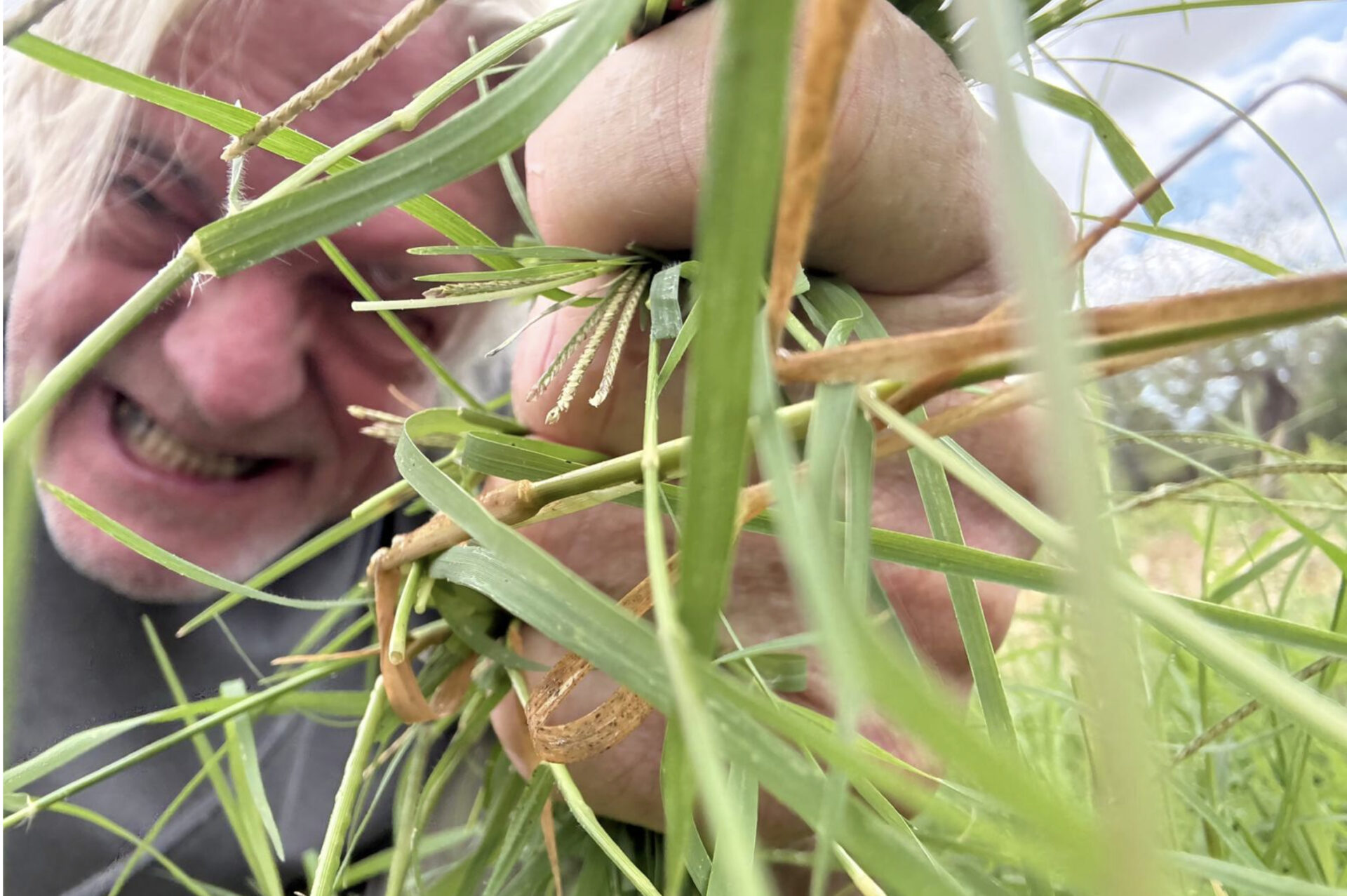
I’m fighting a battle with grass. That may sound a little silly, but once you know how destructive it can be to my land, you probably won’t laugh too hard.
My Sahara grass spreads above and below ground through the patch where I’m trying to grow melons and tomatoes. It’s not a matter of, “Oh, I’ll just pull it out.” Sometimes the roots are thirty centimeters deep, and if you leave one little piece behind, within a month you’ve got a whole patch of grass again.
My neighbors know exactly what to do about it. They spray some kind of poison on it and the grass is gone. So is the rest of the crops, which is why they do it after the harvest. But getting the soil alive again afterwards is a nightmare.
The other day, when I was on my knees for the umpteenth time trying to pull another endless mess of white roots out of the ground, I did have my doubts. Agricultural plastic doesn’t help either. The grass just drills straight through it.
The problem is that my neighbors aren’t stupid. A farmer with ten hectares can hardly go after every blade of grass with a little shovel.
So what is this column about? My lousy hectare and a half?
No. Almost everywhere in the world we have developed an agricultural system in which pesticides seem almost indispensable. We want perfect tomatoes. No worm in the apple. No failed harvest. And above all, cheap food.
There is just one price that doesn’t appear on your supermarket receipt. It says nothing about soil quality or groundwater pollution. It doesn’t say anything about the bee either.
That’s what they’re fighting about in Brussels this week.
A committee of the European Parliament is taking a stand on the use of flupyradifurone. A kind of shit I never heard of. It is an insecticide made by Bayer that attacks the nervous system of insects. It works in a similar way to another group of pesticides, neonicotinoids, which Europe has now largely banned from outdoor use because of the damage they cause to pollinators.
The current European limit is now 0,3 milligrams per kilo. But the European Commission proposed raising it to 0,4 milligrams
You have to imagine Brussels crawling with lobbyists knocking on the doors of members of parliament, civil servants and commissioners. Bayer’s among them.
A tenth of a milligram. What are we even talking about?
But last Thursday, the European Parliament’s environment committee drew a line.
Thirty-nine members voted against the increase. Twenty-five voted in favor. Six abstained. The main argument: the stuff is toxic to bees.
On one side are scientists, environmental organizations and politicians who say we need to become less dependent on these kinds of chemicals. On the other side is a multibillion-dollar industry that produces them, together with large farmers who need to protect their harvests.
The latter have the means to push their point of view. According to data from the European Transparency Register, Bayer alone spent up to eight million euros lobbying the European Union in 2023. Where exactly all that money goes and who benefits from it, I don’t know. The bees certainly don’t.
If it isn’t going into envelopes or fancy trips, there must be a whole army of lobbyists walking around Brussels to spend that much money.
And it is all perfectly legal. I don’t have eight million euros. Neither do the bees.
Vandana Shiva is a hero of mine. She doesn’t have eight million euros either, but she has been fighting for biodiversity and healthy agriculture for decades. She has fought Monsanto, now part of Bayer, and especially an agricultural system in which more and more power over food, seeds and farmland ends up in the hands of a few enormous corporations.
Big multinationals try to claim seeds, some of them ancient, through patents, so they can no longer be freely traded. There have also been attempts to develop seeds that produce sterile plants, meaning farmers cannot save their seeds and plant them again the following year.
Those are the kinds of practices she has been fighting against.
Next week the full European Parliament will have to decide on the objection.
I don’t know whether 0.3 or 0.4 milligrams of flupyradifurone the line is where the world comes to an end. That isn’t really the point.
But how the hell did we end up here?
We make food as cheap as possible. Farmers must produce more efficiently. They can barely afford a failed harvest. So, they use chemicals to fight insects, fungi and weeds. Then we discover that some of those chemicals damage nature and politicians start deciding how much of the stuff is still acceptable.
Maybe someone in 2125 will look back at this and find it very strange.
Maybe they’ll wonder why we spent so much time deciding how much poison could still be left on our food, instead of figuring out how to grow food without needing the poison in the first place. Vandana Shiva thinks we can. I think so too.
But I still have to figure out how to kill that fucking grass with my bare hands.
Back From The Future is a series in which I look back from the year 2125 at the choices we are making today.