#78 – BOARDED UP
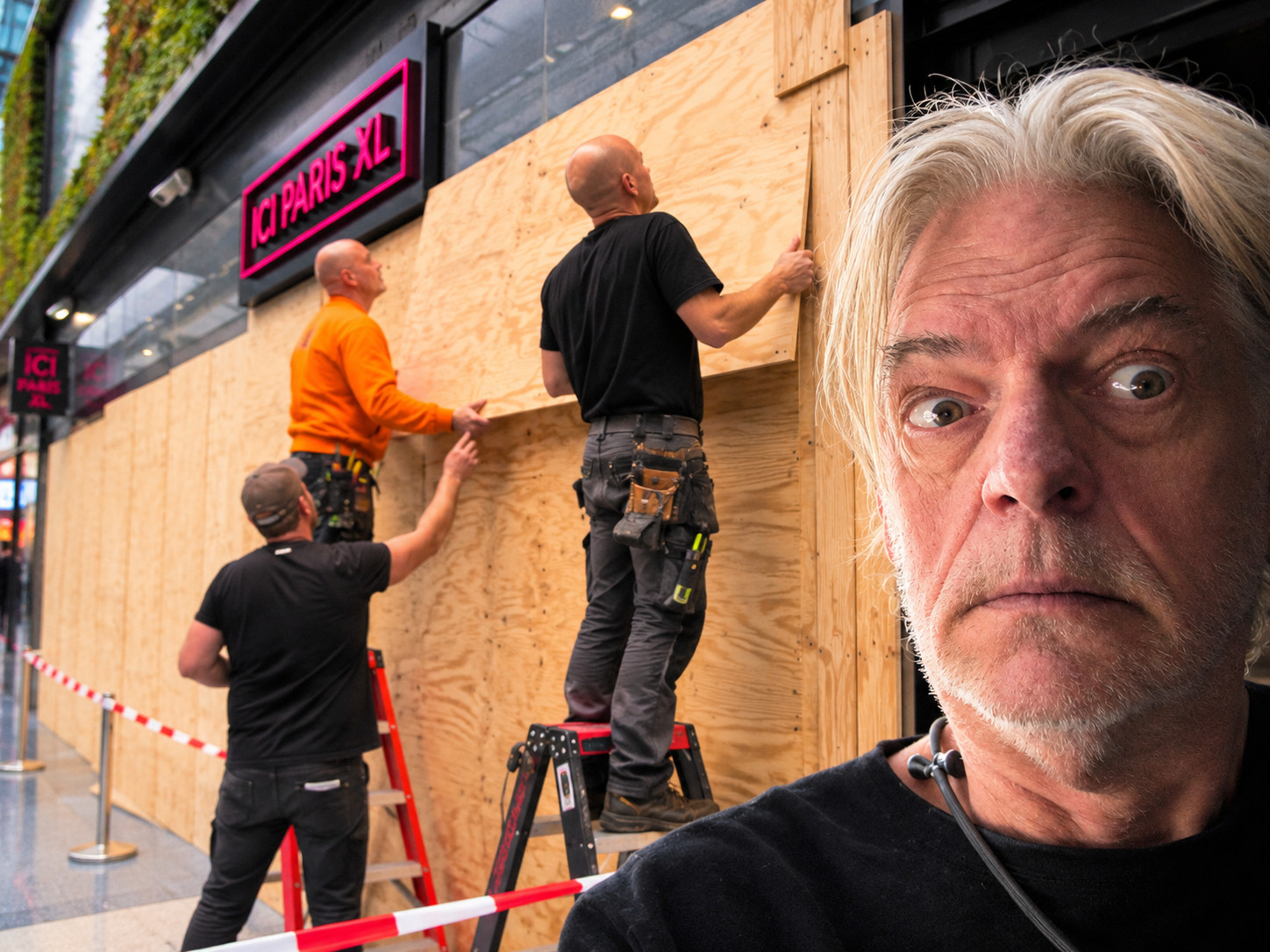
Boarding up shops is easy enough. But what do we do about the future of young people?
My friend Erik is a contractor. Last weekend he got a call on Friday evening. Without wanting to, he became part of the news. His vans went out to board up shops because young people had been calling for demonstrations on the internet. And not just that, because there were also messages saying: “Come on guys, let’s go loot some shops.” Gen Z. That’s the label people like to put on all these emerging protests.
Anyway. The looting never happened in a city tightly sealed off by the police. On Monday he could take everything down again. A few people were arrested, and a police officer was injured by some fireworks.
We wondered how urgent these protests in the Netherlands really are. Especially compared with France. Is it boredom? Hooliganism? Or is there real discontent behind it?
There is certainly reason to protest. In the Netherlands, young people face a housing shortage. Education budgets are being cut. The prospects of an easy life are getting bleaker as governments keep pushing problems into the future. Whether smashing a shop window to steal a pair of sneakers is the best way to protest is of course another question. But those are questions I, as an old timer in activism, am not going to ask.
I’m driving through France now. If you open your car window, you can smell the French Revolution, although we’re staying well away from the Bastille and Paris, where it began. We’re staying in some little village in the middle of France. Villefranche-sur-Saone. Even here the protests reached us. Some weeks ago, pupils at the local lycée hung a white sheet out of the window with the words “Nous sommes la génération de demain. Écoutez-nous aujourd’hui.” Which means: “We are the generation of tomorrow. Listen to us today”. The pupils were protesting crumbling school buildings, overcrowded classrooms and too few teachers. Farmers were protesting nearby too. Among other things, against excessive regulations that make it very difficult to pass their farms on to their children.
And France is not the only country where discontent among young people is growing. In Nepal, young people took to the streets against corruption and the blocking of social media. In Madagascar, it started with water that wouldn’t come out of the tap and an electricity grid that was completely unreliable. In Morocco, young people protested the construction of expensive football stadiums while there was no money for decent healthcare and education. All these protests can’t just be some fad that starts for a laugh.
Of course, it’s not easy for baby boomers like me to explain such an uprising. Although maybe it is. We’re pretty comfortable. Pensions sorted out, or still in a well-paid job. Bought a house in time, which we now have as a little nest egg for our old age. For decades, every year our prosperity grew a little bigger and better. We flew wherever we liked, could study whatever we wanted, eat whatever was available in abundance.
And young people today? They have to work hard to pay rents that are far too high. Prices going through the roof. And the growing realization that everything will only get worse soon.
So, is the revolution coming? The great turnaround brought about by Gen Z? Probably not. They’re not organized, they have no common plan, no ideology, no leaders. Perhaps in some places, like Serbia, where there is a student party that, instead of aspiring to seats in parliament or a minister’s chair for themselves, has simply put smart, independent people on its list. But elsewhere, in Madagascar for example, the army has seized power and they still have no water.
Repression is widespread because the system must be protected. Not even so much because everyone thinks that system is so fantastic, but because nobody knows what should replace it.
For my book, I tried to imagine how we will live in 2125. That inevitably brings you to the question of why housing, education and healthcare must be fought for repeatedly. Surely, we’ve known for a very long time that people need these things?
I imagine a society where you can move into a place of your own even if you don’t have rich parents. Where houses are built and managed to give people somewhere to live instead of making a fortune out of them. That requires different rules for land ownership, financing and the allocation of housing. A subsidy for first-time buyers isn’t enough if prices simply go up again afterwards. But you see, this doesn’t call for changing the rules, it calls for changing the system.
The same goes for education. You can renovate a school, but there also has to be money and time for the people teaching there. Who gets what, who decides, and how do we make sure young people themselves have a say? These problems are connected. You have to change the way we organize society. Otherwise, the children of those kids demonstrating today will be out on the streets with the same complaints.
Anyway. In The Hague, a rather unusual group of guardians of law and order had already volunteered. The hardcore supporters of ADO football club came to protect the city. They themselves wrote: “We’re not against violence; in fact, it’s our hobby.” The riot police had to prevent a confrontation with young people.
If those hooligans, who call violence their hobby, are supposed to restore order, my friend had better hang on to his boards for a while longer.