#52 – The air conditioning trap
On Mallorca, one heat record after another is being broken this summer. And I’m right in the middle of it.
I could quite easily be in Rotterdam right now. My house there is a lot cooler. But my grapes are almost ripe, and I’m not leaving them alone. Every few days, I walk through the vineyard to measure whether they are sweet enough yet to eventually turn into wine with a decent alcohol percentage. And in the meantime, I’m fighting wasps, birds and everything else that likes those grapes at least as much as I do.
Since the beginning of July, with the exception of the odd day, temperatures here have constantly been above 35 degrees Celsius. Regularly approaching or passing forty.
At first, I stuck to the principles of the old Mallorcan. As soon as the temperature drops to 22 or 23 degrees at night, all the windows open. In the morning, before the sun can heat the rooms through the glass, the windows and shutters close again.
It works surprisingly well. When it’s 32 or 33 degrees outside, the temperature inside rises to no more than 26 or 27.
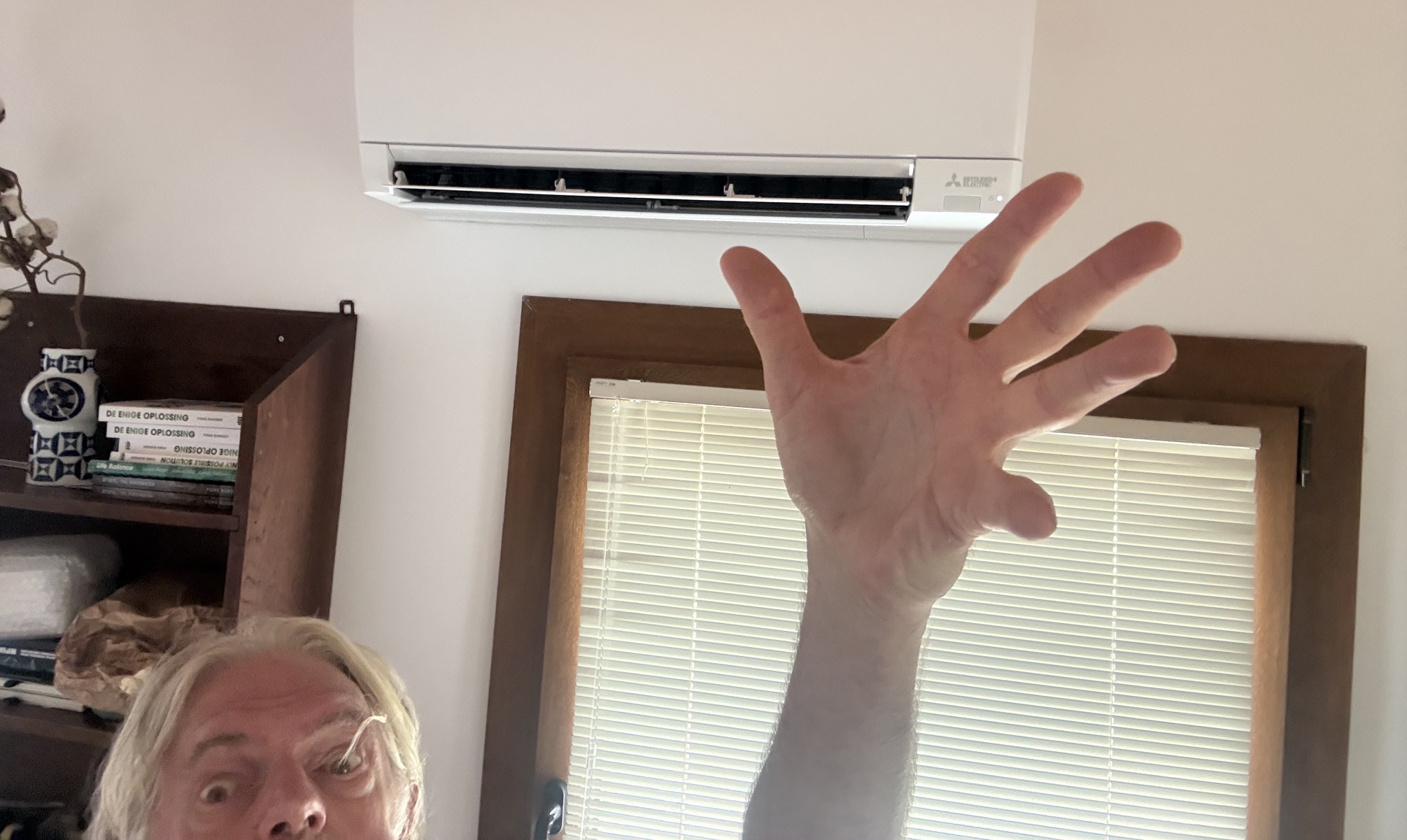
But when it stays around 38 degrees for weeks and the nights barely cool down anymore, there comes a point when there’s no stopping it. So I gave in. I bought an air conditioner for my study and another one for the bedroom.
I’m not even particularly happy with them. I’ve already caught a cold. You have to get out of bed twice a night to drink something because your throat is so dry, and when you step outside during the day, the heat seems to hit you even harder.
A few days ago, I read an article by Dirk Halet of VITO about what he calls the cooling demand ladder. His reasoning is actually very simple: as it gets hotter, we shouldn’t start by asking how we can cool more. We should start by asking how we can avoid needing so much cooling in the first place.
Because air conditioning is a rather strange solution to climate change. We use electricity to remove heat from our homes and then blow that heat outside. In many cities, hundreds of thousands of units are already doing exactly the same thing at the same time. The streets get hotter, electricity demand rises, and so we need even more energy to protect ourselves from the heat.
Then there is water. Power plants and industry use enormous amounts of water for cooling. And precisely during heat waves, when everyone needs more electricity, less cooling water is available and the water that remains is warmer.
So we are building a system that has to work harder and harder just to deal with the consequences of the way the system itself works.
The funny thing is that the old Mallorcans knew part of the solution all along.
Old houses here have thick stone walls, relatively small windows and shutters that keep the sun out before it reaches the glass. Streets in old villages are narrow and shade one another. Courtyards create air circulation. Trees are planted where shade is needed.
Not because anyone was talking about climate adaptation, but because air conditioning didn’t exist.
Looking from 2125, it is therefore difficult to understand why, at the beginning of this century, we built so many buildings that were only habitable as long as there was enough cheap energy available to keep them artificially cool.
In that year, I think it will look something like this.
Homes are designed for the climate they actually stand in, and that means more than solar panels and heat pumps on the roof. It starts with shade, insulation and natural ventilation, thick walls, greenery, water, the boring stuff nobody puts on a brochure. Windows go where they’re useful, not where an architect once thought they’d look good in a render. Trees count as infrastructure now, not decoration. And in cities, whole stretches of stone and asphalt have simply disappeared, because we finally figured out how much heat that stuff soaks up all day and dumps back out at night.
Cooling itself is also different in 2125. Waste heat is used instead of thrown away. Buildings and neighborhoods share heat and cooling. Data centers produce less heat because computers are more efficient. And active cooling only comes at the end of the chain, for those moments when there really is no other option.
Basically, we are going back to building like those old Mallorcans.
But with the knowledge and technology of the 21st century.
My two air conditioners are staying on the wall for now. Because it’s damn hard to write a sensible column or blog when your brain is boiling.
Back From The Future is a series of short stories in which I look back from the year 2125 at the world we are creating today.